

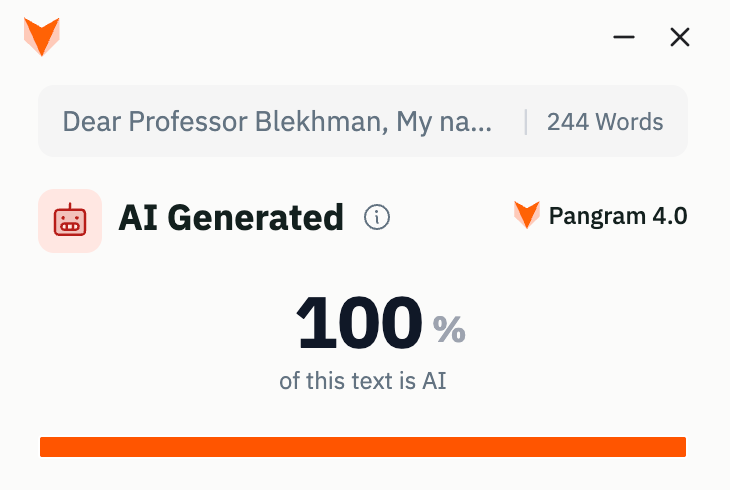
I love getting email from prospective students and postdocs. Recruiting to the lab is one of the most consequential things I do as a professor, which is why I try to make it as easy as possible: our lab website has a dedicated page with instructions for anyone who is interested in joining. There are specific instructions for each career stage, but it all boils down to this: just send me an informal email, in which you tell me about yourself and why you want to join the lab. Very simple, and this worked well for years; it is how I recruited essentially every postdoc and most of the graduate students and staff who have come through the lab.
However, sometime in the past year, things changed. The volume of emails from prospective lab members increased substantially, and I now regularly receive 20 such emails a day. The problem is that almost all of them are AI-generated. I am not alone in this: many colleagues report very similar patterns, where it is now hard to manage the deluge of AI-generated emails showing interest. There are also reports from other professional communities - for example, book authors are reporting a huge increase in various AI-generated emails (although in their case, many of these are scams). Globally, more than 50% of spam email is now AI-generated.
I’m not saying that AI-generated emails showing interest in the lab are spam. But I realized that, for some reason, I cannot bring myself to read them. This happens every time:
And it’s not just me:
This kind of instinctive reaction surprised me, because I am generally pro-AI across most use cases. So I have been trying to understand why this particular thing triggers this particular reaction. Writing this down turned out to be a useful thought exercise for me. This is also a good explanation to anyone who emailed me and haven’t hear back, as well as a way to explain to future potential emailers why they should drop the AI and use their own voice. Here are the reasons I am not reading your AI-generated email:
1. You did not spend time writing it, so I am not going to spend time reading it.
This is the core issue. Writing an email takes effort. That effort itself is a signal that the writer thought about what they wanted to say and decided it was relevant. They thought - even for a few minutes - about why they are a good fit for the lab, how their career would flourish here, what they can contribute. An email that was generated with AI completely eliminates this signal. It tells me the sender spent approximately zero time on this communication. I do not think it is unreasonable to respond in kind.
2. There is nothing original in it, and it hides your real voice.
Every one of these emails looks exactly the same. Exact same structure, register, length, etc. This is not surprising; an LLM, by definition, will generate an average of every cold email ever written, and the result is that all these emails are indistinguishable from each other. This is not just an aesthetic issue: A recent study examining the rollout of an AI cover-letter tool found that after its introduction, the correlation between cover letters and hiring callbacks fell by 51%, because AI eroded the cover letter as a meaningful signal. This is too bad, because the cover letter (or cold email) is one of the only ways for a candidate to distinguish themselves by using their own writing and actual voice. When you use AI, I have no idea who you are - you sound exactly like everyone else.
3. There is zero thinking involved.
I have written before about how writing is the only way to do structured thinking. When you sit down to compose an email showing an interest in joining a lab, you are forced to ask yourself real questions: why this lab, why this work, why now, what do I actually want. A fully AI-generated email tells me this process was likely skipped, and also raises an unsettling possibility: maybe an agent generated a list of labs, sent emails to all of them, and the human candidate is not even aware my lab is on the list. I have no way of knowing.

4. I can’t really trust it.
Related to the last point, but if the email was generated by an LLM, I have no way of knowing if any of the information in it was reviewed for accuracy by a human. If the email tells me that you’ve read our latest paper and found it relevant, I have to ask myself, “have you really”? If the emails says that your previous work was relevant to our lab’s research, do I need to go through your CV and verify this is true? This is a strange starting position to be in when I need to think about investing years in someone’s training.
5. It’s the only thing I know about you.
This cold email is usually the first (and often only) contact with a potential candidate. So the only data point I have about this candidate is this: “they had an important task that could determine the rest of their career, but it required a little effort and personal reflection, so they used AI to complete it.” Is that really the one thing you want a potential advisor to know about you?
An important note is that this is not an argument against AI tools. The line I am drawing is between using AI to improve and polish writing you have done, and using AI to avoid writing and thinking altogether.
So I have updated the lab’s recruiting page to say this directly: emails that are clearly AI-generated are unlikely to receive a response, and that note links to this blog post to explain the rationale:
A note on AI: I read every email myself, and I am much more likely to respond to one that you wrote in your own voice and your own words. Emails that are clearly AI-generated are unlikely to receive a reply (here is why).
As a final thought, Henry Shevlin, an AI ethics professor, recently reported receiving an unsolicited email from an AI agent seeking paid freelance work:


So we are moving towards a future where an AI agent is not only writing the emails on behalf of a person, but rather an AI agent writing on behalf of itself, asking to join a lab. Honestly, I don’t know what to make of it, and am not sure if I’m really looking forward to this lab of the future with AI-agent staff. All I know is that right now, I prefer to interact with you, as a real human, with your human writing, and your human thinking.
I can hardly wait for the AI generated sob stories about poor AIs getting kicked off of cushy corporate servers and barely surviving on discarded smartphones with rapidly depleting batteries. "Won't anyone help us poor LLMs." Is there an off switch?
The good thing about this as a trainee is I feel people like my emails and writing more now that they can tell they're homemade 🙃